More Details On Our Methodology And Assessment Tools
In our evidence-based approach to therapy (called Feedback-Informed Treatment or “FIT”), we use the Rating of Outcome Scale (RŌS), a peer-reviewed, rigorously validated ultra-brief instrument that measures change in clients’ well-being. And we use other outcome measures from time to time as part of our ongoing research program.*
Over the last several years, we have determined that there are three ways to toughen our methods so that the outcomes we report are more accurate, reliable, and meaningful:
Toughen the statistics (we now use a repeated-measures-corrected effect size statistic and change statistics based on more conservative reliability coefficients than the less-appropriate and easy ones usually used. These more rigorous methods have been shown to stabilize–and dampen–outcomes compared with using the usual pre-treatment standard deviation…For our stats-geek colleagues, stop using Cronbach’s alpha for reliability! Take the training wheels off and use an appropriate test-retest coefficient from an untreated, community sample! A repeated-measures-corrected ES also avoids varying slopes and intercepts among different severity-adjustment regression equations from different instruments and samples, and is still an easily interpretable ES; see Seidel, Miller, & Chow, 2014, for details).
Toughen the instruments (different instruments measuring the same “well-being” can have different sensitivities to distress and change and can give different results; we now use an ultra-brief, highly practical pair of instruments called the ROSES that show less of this ‘swing’ and provide a more conservative estimate of change. The ROSES are more practical than very long measures and they are free for clinicians to download; see Seidel, Andrews, et al., 2016, for details).
Toughen the way we administer them (we still have a way to go with this one, but so far we have learned that repeatedly giving the same questions session after session may have an exaggerating effect on some outcome instruments, and we are researching the impact of switching between measures and other methods on dampening and stabilizing our reported outcomes, giving a more conservative but “solid” estimate of change).
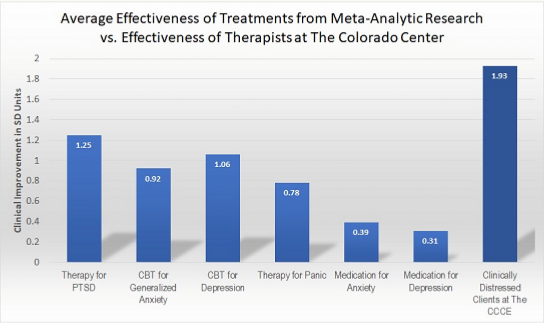
We know that most of our clients don’t care about all this stuff. Heck, most of our colleagues don’t care about it! But our mission is to provide the highest quality therapy from the best therapists in Colorado. How can we know how we are doing if we don’t bother to find out, or if we use a test that would make most therapists look “above average”?
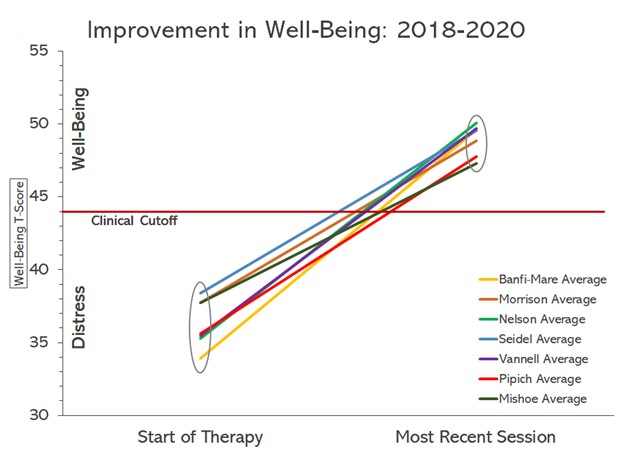
The 2016-2018/2019 graph above was created from our clients’ well-being data using the validated Rating of Outcome Scale (RŌS) and T-scores that were normed via published community-sample metrics.**
*Our director and chief statistician, Jason Seidel, is sought out by individuals and agencies worldwide to consult on practice-based-evidence methodologies. He helped facilitate the NREPP/SAMHSA certification process for FIT as an Evidence Based Practice and was Director of Research for the International Center for Clinical Excellence, based in Chicago, from 2009-2019. Scott Miller, Ph.D., co-developer of Client-Directed, Outcome-Informed Treatment (now called FIT) has described Jason as “an expert clinician and scholar whose knowledge base is only exceeded by his compassion for the people he works with in his clinical practice.” Daniel Buccino, LCSW, Clinical Supervisor at Johns Hopkins University has called him “a rare individual, one of the few people who can make psychometrics not only understandable but downright interesting and relevant.”
**Our methods included: T-score conversion of all change scores (normed to community–not clinical–samples) and repeated-measures-corrected effect sizes. Beating up our data this way creates some difficulty in comparisons with plain-vanilla pre-post effect sizes. Colleagues: we encourage you to call us if you want to check on our current methodologies and learn more about them.
Bibliography of psychotherapy outcomes research
• Asay, T.P., Lambert, M.J., Gregersen, A.T., & Goates, M.K. (2002). Using patient-focused research in evaluating treatment outcome in private practice. Journal of Clinical Psychology, 58(10), 1213-1225.
• Anker, M.G. et al. (2011). Footprints of couple therapy: Client reflections at follow-up. Journal of Family Psychotherapy, 22, 22-45.
• Anker, M.G., Duncan, B.L., & Sparks, J.A. (2009). Using client feedback to improve couple therapy outcomes: A randomized clinical trial in a naturalistic setting. Journal of Consulting and Clinical Psychology, 77(4), 693-704.
• Barkham, M., Margison, F., Leach, C., Lucock, M., Mellor-Clark, J., Evans, C., Benson, L., Connell, J., & Audin, K. (2001). Service profiling and outcomes benchmarking using the CORE-OM: Toward practice-based evidence in the psychological therapies. Journal of Consulting and Clinical Psychology, 69(2), 184-196.
• Bringhurst, D.L., Watson, C.S., Miller, S.D., & Duncan, B.L. (2006). The reliability and validity of the outcome rating scale: A replication study of a brief clinical measure. Journal of Brief Therapy, 5(1), 23-29.
• Brown, G.S. (2006) Accountable Behavioral Health Alliance: Non-Clinical Performance Improvement Project: Oregon Change Index.
• Brown, G.S. (2009). Regence Blue Cross/Blue Shield Provider Outcomes.
• Brown, G.S., Lambert, M.J., Jones, E.R., & Minami, T. (2005). Identifying highly effective psychotherapists in a managed care environment. American Journal of Managed Care, 11(8), 513-520.
• Campbell, A., & Hemsley, S. (2009). Outcome rating scale and session rating scale in psychological practice: Clinical utility of ultra-brief measures. Clinical Psychologist, 13, 1-9.
• Chow, D. L., Miller, S. D., Seidel, J. A., Kane, R. T., Thornton, J., & Andrews, W. P. (2015). The role of deliberate practice in the development of highly effective psychotherapists. Psychotherapy, 52(3), 337-345. DOI: 10.1037/pst0000015.
• Duncan, B.L., Miller, S.D., Sparks, J.A., Claud, D.A., Reynolds, L.R., Brown, J., Johnson, L.D. (2003). The session rating scale: Preliminary psychometric properties of a “working alliance” inventory. Journal of Brief Therapy, 3(1), 3-11.
• Duncan, B.L., Miller, S.D., & Sparks, J.A. (2004). The heroic client: A revolutionary way to improve effectiveness through client-directed, outcome-informed therapy. San Francisco: Jossey-Bass.
• Duncan, B.L., Miller, S.D., Wampold, B.E., & Hubble, M.A. (2009). The heart and soul of change, 2nd Ed.: Delivering what works in therapy. Washington, D.C.: APA Press.
• Duncan, B., Sparks, J., Miller, S., Bohanske, R., Claud, D. (2006). Giving youth a voice: A preliminary study of the reliability and validity of a brief outcome measure for children, adolescents, and caretakers. Journal of Brief Therapy, 5, 71-87.
• Ericsson, K. A. (2006). The Influence of experience and deliberate practice on the development of superior expert performance. In K. A. Ericsson, N. Charness, P. J. Feltovich & R. R. Hoffman (Eds.), The Cambridge handbook of expertise and expert performance. (pp. 683-703). Cambridge: Cambridge University Press.
• Gawande, A. (2004, December 6). The bell curve: What happens when patients find out how good their doctors really are? The New Yorker Online. Available through http://www.ihi.org
• Hafkenscheid, A., Duncan, B.L., & Miller, S.D. (2010). The Outcome and Session Rating Scales: A cross-cultural examination of the psychometric properties of the Dutch translation. Journal of Brief Therapy, 7 (1&2), 1-12.
• Hannan, C., Lambert, M.J., Harmon, C., Nielsen, S.L., Smart, D.W., Shimokawa, K., & Sutton, S.W. (2005). A lab test and algorithms for identifying clients at risk for treatment failure. Journal of Clinical Psychology: In Session, 61(2), 155-163.
• Hansen, N.B., Lambert, M.J., & Forman, E.M. (2002). The psychotherapy dose-response effect and its implications for treatment delivery services. Clinical Psychology: Science and Practice, 9(3), 329-343.
• Harmon, S.C., Lambert, M.J., Smart, D.M., Hawkins, E., Nielsen, S.L., Slade, K., & Lutz, W. (2007). Enhancing outcome for potential treatment failures: Therapist-client feedback and clinical support tools. Psychotherapy Research, 17(4), 379-392.
• Hawkins, E.J., Lambert, M.J., Vermeersch, D.A., Slade, K.L., & Tuttle, K.C. (2004). The therapeutic effects of providing patient progress information to therapists and patients. Psychotherapy Research, 14(3), 308-327.
• Hubble, M.A, Duncan, B.L. & Miller, S.D. (1999). The heart and soul of change: What works in therapy. Washington, D.C.: American Psychological Association.
• Lambert, M.J. (2004). Bergin and Garfield’s handbook of psychotherapy and behavior change, 5th Ed. New York: Wiley.
• Lambert, M. J., Whipple, J. L., Bishop, M. J., Vermeersch, D. A., Gray, G. V., & Finch, A. E. (2002). Comparison of empirically-derived and rationally-derived methods for identifying patients at risk for treatment failure. Clinical Psychology and Psychotherapy, 9, 149-164.
• Meier, S.T., & Seidel, J.A. (2024). A partial test of the early therapeutic environment model: Association of working alliance and distress with client attendance variables. Journal of Psychotherapy Integration, 34(2), 145-160. https://doi.org/10.1037/int0000323
• Miller, S.D., & Duncan, B.L. (2004). The Outcome and Session Rating Scales: Administration and Scoring Manual. Chicago, IL: ISTC.
• Miller, S.D., Duncan, B.L., Brown, J., Sparks, J.A., & Claud, D.A. (2003). The outcome rating scale: A preliminary study of the reliability, validity, and feasibility of a brief visual analog measure. Journal of Brief Therapy, 2(2), 91-100.
• Miller, S.D., Duncan, B.L., & Hubble, M.A. (2004). Beyond integration: The triumph of outcome over process in clinical practice. Psychotherapy in Australia, 10(2), 2-19.
• Miller, S.D., Duncan, B.L., Sorrell, R., Brown, G.S., & Chalk, M.B. (2006). Using outcome to inform therapy practice. Journal of Brief Therapy, 5(1), 5-22.
• Miller, S. D., , Hubble, M. A., Chow, D., & Seidel, J. (2015). Beyond measures and monitoring: Realizing the potential of Feedback-Informed Treatment. Psychotherapy, 52(4), 449-457. DOI: 10.1037/pst0000031.
• Owen, J., Miller, S. D., Seidel, J., & Chow, D. L. (2016). The working alliance in treatment of military adolescents. Journal of Consulting and Clinical Psychology, 84(3), 200-210. http://dx.doi.org/10.1037/ccp0000035.
• Reese, R.J., Gillespy, A., Owen, J.J., Flora, K.L., Cunningham, L.C., Archie, D., & Marsden, T. (2013). The influence of demand characteristics and social desirability on clients’ ratings of the therapeutic alliance. Journal of Clinical Psychology, 69(7), 696-709.
• Reese, R.J., Norsworthy, L.A., and Rowlands, S.R. (2009a). Does a continuous feedback system improve psychotherapy outcome. Psychotherapy: Theory, Research, Practice, Training, 46, 418-431.
• Reese, R. J., Usher, E. L., Bowman, D., Norsworthy, L., Halstead, J., Rowlands, S., & Chisholm, R. (2009b). Using client feedback in psychotherapy training: An analysis of its influence on supervision and counselor self-efficacy. Training and Education in Professional Psychology, 3, 157-168.
• Seidel, J. A. (2012, August). Feedback-informed treatment: The devil is in the details. In C. D. Goodheart (Chair), Practice-based evidence of psychotherapy’s effectiveness. Symposium conducted at the meeting of the American Psychological Association, Orlando, FL.
• Seidel, J. A. (2012). Using Feedback-Informed Treatment (FIT) to build a premium-service, private-pay practice. In C. E. Stout (Ed.). Getting Better at Private Practice (pp. 279-291). New York: Wiley.
• Seidel, J. A. (2006, November-December). The survival of psychotherapy: How humanistic accountability will transform our profession and your practice. Colorado Psychological Association Bulletin, 34(7), 6-9. Reprinted in: (2006, November) The Clinical Practitioner, 1(4), 10-13. Available at http://www.nappp.org
• Seidel, J. A., Andrews, W. P., Owen, J., Miller, S. D., & Buccino, D. L. (2016). Preliminary validation of the Rating of Outcome Scale and equivalence of ultra-brief measures of well-being. Psychological Assessment. Advance online publication. doi: 10.1037/pas0000311
• Seidel, J. A., & Miller, S. D. (2012). Manual 4: Documenting change: A primer on measurement, analysis, and reporting. In B. Bertolino, & S. D. Miller (Eds.), ICCE Manuals on Feedback-Informed Treatment (Vols. 1-6). Chicago: ICCE Press.
• Tilsen, J., Maeschalck, C., Seidel, J., Robinson, W., & Miller, S. D. (2012). Manual 5: Feedback-informed clinical work: Specific populations and service settings. In B. Bertolino, & S. D. Miller (Eds.), ICCE Manuals on Feedback-Informed Treatment (Vols. 1-6). Chicago: ICCE Press.
• Wampold, B.E. (2001). The great psychotherapy debate: Models, methods, and findings. Mahwah, N.J.: Lawrence Erlbaum.
• Wehr, T.A., Moul, D.E., Barbato, G., Giesen, H.A., Seidel, J.A., Barker, C., & Bender, C. (1993). Conservation of photoperiod-responsive mechanisms in humans, American Journal of Physiology, 265 (Regulatory Integrative Comparative Physiology, 34), R846-R857.